Showing posts with label Cuts. Show all posts

Climate of Fear in the NHS

Saturday, 8 October 2011


“The last chance to save the NHS” is how it has been billed. This Sunday thousands from across the country are expected to descend on London to launch a headline-grabbing demonstration against the coalition government’s proposed healthcare reforms.

Led by the anti-austerity group UK Uncut, the protesters plan to temporarily close down the iconic Westminster Bridge just days before a crucial parliamentary debate on the controversial Health and Social Care Bill. If the Bill is passed into law, campaigners say, it will open the NHS up to corporate interests, damage the standard of service and lead to the destruction of an equal and universal healthcare system.

But in the build up to the demonstration, an investigation by The Big Issue in the North has discovered frontline NHS staff across England are already enduring cutbacks that could be putting patient care at risk, with some surgeries being delayed due to tight budgets.

Speaking on the condition of anonymity, Dr Stephen Smith (not his real name), said at one hospital in the south west of England staffing was at a “dangerous level” after the ratio of nurses to patients in each ward had been reduced.

“There is a climate of fear and a feeling that everyone’s budgets are under heavy attack,” he said. “Working in A&E for example there are signs up saying ‘how can we save money’, with people asked to give suggestions. But the amount that’s having to be saved each month is just crazy, and consequently rotas are being designed with less doctors in them because it’s cheaper. Which clearly puts patients at risk.”

Smith added that he believed the Health and Social Care Bill would send things in a “very bad direction”.

“There isn’t anybody I know in the medical profession that thinks it’s a good idea. Everyone has said that this is going to destroy the NHS and is just an attempt at backdoor privatisation. The only people who are pro it are the GPs who are going to make money out of it,” he said.

Jacqui Moore (not her real name), a specialist practitioner who is also a union representative at a hospital in the north west of the country, described increased levels of stress due to a string of job cuts.

“I see alot of staff going off with stress at the moment. The minute you start cutting staff everybody else is just expected to work harder and a lot of staff react to that. They just can’t cope with it. Just about every person I deal with seems to have either been off with stress or has just come back after a period of stress-related illness. Everybody is feeling the pressure.

“I think it’s just symptomatic of what’s going on in the health service as a whole. The whole agenda is very cost driven, and every decision that seems to be made is a financial one, rather than one that’s got patient care at the end of it.”

Shortly after coming to power in May 2010, the coalition government gave an assurance that its cuts agenda would not impact upon frontline services. And in April this year the government launched a “listening exercise” to address concerns about the scale of its NHS reforms.

Launching the initiative, prime minister David Cameron said the government wanted to “safeguard the NHS for future generations”, but added that it was only through “modernisation that we can protect the NHS and ensure the country has a truly world-class health service.”

Months after the listening exercise, however, the British Medical Association (BMA), which represents around 141,000 doctors and medical students in the UK, called for the Health and Social Care Bill to be “withdrawn or at the very least significantly amended.”

“The clear view of BMA Council is that the Health and Social Care Bill remains deeply flawed,” said Dr Hamish Meldrum, the council’s chairman. “The BMA will continue to publicly and vigorously highlight the concerns of doctors and patients, particularly to peers who have a real opportunity to protect the NHS by addressing the damage that could be done by many aspects of these reforms.”

One long-serving nurse at a hospital in south London, Mike Davey, told The Big Issue in the North the fear is that the standard of service – and ultimately patient care – will be severely compromised by the changes.

“There’s a nervous anticipation and a lot of staff are very concerned. It’s having a negative impact on morale,” he said. “This particular government is putting thumb screws on to the managers, the executives and the trust boards so they have to pretty much market test everything – which means services being privatised out.

“We’re told a private company can do things cheaper and better than our own in-house services. But previous experience, since the Thatcher government in the 80s brought in mass privatisation, has led us to see that this is not actually the case.”

At a hospital on the outskirts of Manchester, some surgeries may have already been rationed due to budget shortages.

According to Oldham and Saddleworth MP Debbie Abbrahams, a 33-year-old man in her constituency had an operation to fix his cataracts delayed because his sight was classed as "impaired" as opposed to "blind". The man, an engineer by trade, cannot work due to his condition and will have to wait until his vision worsens before he can undergo immediate surgery.

"Delays to simple and relatively inexpensive operations, like those for cataracts, can severely affect a person's life,” Abbrahams said. “I am very concerned about this situation as I have had several constituents come to me asking for help because they cannot get their cataracts treated in a reasonable time. Along with Michael Meacher and other Greater Manchester MPs I am asking Oldham's Primary Care Trust for clear answers about why this and other basic operations are being hit so hard by this government's ideologically driven cuts."

On 11 October the Health and Social Care Bill will be debated at length in the House of Lords. The Lords can propose amendments to the Bill, with some Liberal Democrat peers, led by Baroness Shirley Williams, expected to rebel against it. Writing in the Observer last month, Williams said that she had “huge concerns”, adding: “The battle is far from over.”

For Ben Jackson, a spokesman for UK Uncut, this Sunday’s protest will be crucial.

“It all depends on what they [the Lords] hear from the public,” he said. “So we need to take drastic action to make it clear that this isn’t going to be something we’re just going to lie down and take. This is something we really care about. It’s an emergency for the NHS."


This article first appeared in issue #896 of The Big Issue in the North magazine.

On the Frontline with the Black Bloc

Sunday, 27 March 2011


There was a carnival atmosphere in London’s Trafalgar Square early yesterday afternoon, but it didn’t last for long. As part of the Trades Union Congress (TUC) organised anti-cuts demonstration in the capital, thousands had gathered to ‘March for the Alternative’. Children were dancing to the sound of samba drums and policemen were smiling and chatting among themselves. Not all groups, however, came for what the TUC had billed as a ‘family event’.

As a crowd of between 250,000 to 400,000 moved slowly from the Victoria Embankment towards Hyde Park, a large splinter demonstration broke off in another direction. It was a group made up of those usually cast in the media as ‘anarchists’ or the 'Black Bloc' – rule breakers with little interest in establishment approved methods of protest. Carrying red and black flags, they walked through the streets with no predefined destination or plan. Some armed with smoke bombs and paint balls, their main intention seemed to be to outsmart the police at any and every opportunity.

It started out as a game of cat and mouse. Running from street to street, chanting and generally causing a spectacle. Tourists and shoppers looked bewildered on Oxford Street as the group, many with their faces covered, some wearing yellow helmets, marched down the road chanting about “Tory scum” and “class war”. The police tried to keep up, but the anarchists managed to stay one step ahead by shifting direction at times almost spontaneously. Their leaderless structure seemed to confuse the police who, at least early in the day, appeared to have been caught entirely off guard.

What started as a game, though, quickly became much more serious. The first sign that things were about to get ugly was at around 3pm, when there was a scuffle between protesters and a police Further Intelligence Team, who were trying to film for surveillance purposes. Moments later a riot van was attacked and spraypainted and events quickly began to spiral. The women’s lingerie shop Ann Summers had its window smashed and was left daubed with graffiti saying “fight sexism”. A member of the shop’s staff stood outside, inspecting the damage. Her face was pale with shock.

What followed was a series of events that ended in several violent confrontations with the police. Banks accused of tax-avoidance, Lloyds TSB and Santander, were paintbombed and had their windows smashed. Then, not long after the group had been chanting “1, 2, 3, 4, escalate the class war”, the five-star Ritz Hotel had metal poles thrown through its windows. Like the poll tax riot of 1990, the wealthy had themselves become an explicit target. Running through prosperous Mayfair with police helicopters hovering above, a Porsche garage had its windows broken. At one point an affluent looking gentleman hauled his children inside his townhouse and slammed the door shut. Neither he nor his children’s safety was at risk, but the fact that he seemed to feel threatened spoke volumes.

Somewhere on Davies Street in Mayfair, a policeman named Inspector Wood was trailing one of the splinter groups while speaking to a colleague on his radio. “They've had a pop at us already,” he said, “so we're well up for it." It wasn’t long before he got his opportunity. In several chaotic incidents between Oxford Circus and Piccadilly, police became increasingly aggressive. Using their shields as weapons, they forced back anyone who got in their way. One middle-aged woman was hit across the face at force with an officer’s shield and I was dealt a blow in the chest as I tried to record a video. Attempting to show my press card I was shoved backwards and tripped over the pavement, held upright only by the crowds behind me. “I don’t care!” one of the officers shouted back in my direction.

The worst was still to come. As darkness fell, there was an air of lethargy among the protestors, who had now convened at Piccadilly Circus. Marshmallows were being toasted on burning placards and there were a few drunks dancing round the fire. Eventually there was movement. A group shuffled down towards Regent Street and others sharply followed. Suddenly there was a confrontation with the police. Black-clad riot officers wielding shields and batons emerged and objects were thrown towards them. The police had blocked off Regent Street and this caused animosity. “Whose streets? Our streets!” the protesters chanted.

The police tried to push people back. It wasn’t just the anarchists now, but various other stragglers including some who appeared to have just tagged along to see what the noise was all about. I was forced down a dark side street as the police attempted to form a kettle and immediately sensed danger. Several of the riot police, who had their faces covered with black masks, could be seen lashing out with their batons. There was an occasional yelp of pain as the police lunged forward and shouted in unison, “MOVE!” I noticed couples in a nearby restaurant looking out at the scene over a glass of wine, watching as if it was all some kind of twisted reality television show.

Suddenly, and without warning, the police charged forward into a sprint. I tried to pull myself into a doorway in the hope that they would run right past me – but I never made it in time. Before I knew it a line of police were right behind me and swinging their truncheons. I glanced back just in time to catch the eyes of one of them, his face hidden by his mask, truncheon held in the air. There was a moment of sheer panic and total fear. I turned again to run and felt a thud and a sharp pain ripple across my back – then again … and again … and again. A young woman was on the ground and people were scrambling over the top of her to escape from the police. I was trying to run but couldn’t move because of the crowds. Eventually I managed to get away, sprinting until I was clear of the police. At the top of the street I fell to my knees, my whole body shaking, my back throbbing with pain.

I spoke to others, many of whom had also been beaten as they tried to flee. One girl in her early twenties lay crying against a concrete pillar in a state of shock. I checked the street for CCTV cameras – there was none in sight. I tried to question police about the incident, but was fobbed off. None of them claimed to have seen what happened and even told me they doubted my version of events. “Take it to the IPCC [Independent Police Complaints Commission],” I was told dismissively.

Today, like after the student protests last year, the focus and the debate has been on the trouble and the troublemakers. The scenes at Regent Street later spread to Trafalgar Square, and the natural impulse of most people has been to jump to the defence of police officers. They have a hard job, ultimately, and when people are smashing up banks and throwing paint and other projectiles all day, surely a few baton charges here and there is to be expected. In reality it is far more complicated.

From what I seen yesterday, police tactics seemed to directly antagonise protesters and inflame violence. The rigid dichotomy between police and protesters (particularly 'anarchists') is a false one. There are protesters who are trouble just as there are also policemen who are trouble. Like Inspector Wood, whom I overheard telling a colleague he was “up for it”, there are officers who like a scuffle; they enjoy the thrill of chasing protesters through the streets and they may even be exhilarated by the prospect of violence.

If a policeman hammers a woman across the face with his shield, it is likely some protesters will react by throwing a few objects in retaliation. If an innocent, law-abiding person is battered across the back and legs for being in the wrong place at the wrong time, he or she will begin to question the legitimacy of police authority. Until the police and the wider public realise this and respond accordingly, we will continue to see scenes like we did yesterday at every single large demonstration.

Many of this morning’s newspapers are unsurprisingly filled with moral indignation at yesterday’s scenes. The Telegraph describes “mobs of masked thugs” and Scotland Yard Commander Bob Broadhurst is widely quoted condemning “mindless yobbery”. But this lacks balance and misrepresents the perpetrators. The targeted acts of disruption and property damage were carried out and cheered on by large numbers of (predominantly) young people who appear to be both politically engaged and intelligent. However you judge their actions, bear in mind first that they are responding in such a way because they feel detached, alienated and disenfranchised from a society and a political system that to them appears unjust, unequal, broken and hopeless.

When the police attack protesters, it only reinforces this sense of isolation and injustice. For every baton charge, for every shield across the face, the anger deepens. What I observed on the streets of London yesterday reaffirms a belief I have held since I witnessed similar scenes in Edinburgh during the G8 protests six years ago: that there is simply not enough independent scrutiny of police tactics and the mainstream media are far too quick to uncritically adopt the perspective of the authorities.

In the months ahead there will no doubt be more unrest on the streets of London. The anger is yet to peak – youth unemployment is at its highest ever recorded level and the cuts are still to fully bite. Unless the police are subject to the same criticism and scrutiny as are the protesters, next time there is a similar protest more windows will be broken and the police will continue to issue out indiscriminate beatings down dark side streets when they think no one is watching. This is something that should give us all cause for concern. We must remember, after all, that it is the role of the police in any democratic society to serve, not to subjugate.


This article appeared originally at: http://www.opendemocracy.net/ourkingdom/ryan-gallagher/baton-charged-by-police-on-frontline-with-black-bloc

Clegg, Cameron and Privatisation

Wednesday, 23 February 2011


Deputy prime minister Nick Clegg was the opening keynote speaker at the the Guardian’s Public Services Summit in St Albans 12 days ago. A two day discussion of “structural challenges facing the country”, the summit was attended by “public service deliverers” including “forward thinking chief executives, elected members [and] civil servants”.

Clegg, who had been greeted by protesters on his way to the summit, took the stage to fairly muted applause before setting the tone of his speech. “How can we reinvent and strengthen our public services at a time of anxiety and stretched resources?” he asked. “And how can we preserve the public sector ethos as we move to a more plural, diverse and personalised way of running our public services?”

He went on to propose that the answer was “modernisation”. Quoting from the Beveridge Report, he stated his belief that public services were about “co-operation between the state and the individual.” Health Secretary Andrew Lansley’s NHS reform would readdress an uneven balance between state and individual, he said, by putting power back “in the hands of those who understand patients, the GPs.”

Then after talking at length about scrapping the burden of bureaucracy and target culture from the public services, he came to a crucial point. He wanted to reassure those “anxious about the claims that what the government is doing is privatising for ideological reasons."

“New and alternative providers – from the private, community and voluntary sectors – have a vital role to play in our public services,” he said. “But I will also take a hard line against the kind of blanket privatisation which was pursued by governments in the past. Because replacing a public monopoly with a private monopoly achieves nothing but reduced accountability.”

Most of Clegg’s speech – about “diversifying” and “modernising” public services – was familiar, and his use of similar language has been questioned on ourKingdom before. However his claim that he would take a “hard line against blanket privatisation” was a significant revelation.

And here’s why. Just ten days on from Clegg’s speech, David Cameron wrote a piece in the Telegraph. In it, he explained how his government plans to implement privatisation on a level that even Margaret Thatcher on her wildest nights would never have imagined possible. “We will soon publish a White Paper setting out our approach to public service reform,” Cameron wrote. “It will put in place principles that will signal the decisive end of the old-fashioned, top-down, take-what-you're-given model of public services.”

Appearing to directly contradict the words of his deputy days earlier, what Cameron outlined was a radical picture of what can only be understood as blanket privatisation.
“The grip of state control will be released and power will be placed in people's hands,” Cameron asserted. “There will be more freedom, more choice and more local control.”

His words were chosen very carefully, with euphemism adopted to conceal the gravity of the plans. Instead of privatisation, he refers to “diversity”; and he makes no mention of capitalism or marketisation, rather “freedom”.

“[We have] a vision of open public services – and we will make it happen by advancing some key principles,” Cameron says. “The most important is the principle of diversity. We will create a new presumption … that public services should be open to a range of providers competing to offer a better service.”

At his summit speech days earlier, Clegg had said: “there will be no for-profit providers in our publicly funded schools system.” But not according to Cameron.

“Of course there are some areas – such as national security or the judiciary – where this wouldn't make sense,” Cameron says. “But everywhere else should be open to diversity; open to everyone who gets and values the importance of our public service ethos.”

The prime minister and his deputy, then, do not seem to share the same vision of the future under these plans. Clegg admits there will be privatisation, but not on the scale proposed by Cameron. And while the differences between the two are currently simmering under the surface, they will surely soon begin to boil.

In no uncertain terms, the Open Public Services white paper will, as it stands, tear down the last vestiges of the public sector. Almost everything will become fair game as the profit-driven interests of private enterprise gradually swallow up public services. With the implementation of market principles, services that ‘fail’ – including hospitals – could be made bankrupt. Oliver Huitson has argued elsewhere that the market relies upon such failure; it is simply an economic eventuality. Under similar plans, for instance, the government owned Forensic Science Service has already been made to close in 2012, as it runs at a cost not a profit.

David Cameron says that the coalition’s plans are not ideological. “We need a complete change,” he argues. Yet as far back as 2006, doctors were asserting that they did not want to see more privatisation of the NHS in England. Since then widespread dissaproval has remained prevalent across the health sector, and as Allyson Pollock has recently noted, the BMA, the Royal College of Nursing and the NHS Confederation have all opposed the coalition's plans. Privatisation is “not in the best interests of the staff and patients," said Karen Reay of the Unite union last week. This government, however, does not appear to care – and neither is it willing to listen.

But amid the cacophony of voices shouting about the coalition's proposed reforms, cuts and all the other tumultuous changes rippling across the world at present, Clegg has offered a quiet assurance that he will “take a hard line against blanket privatisation.” This time, unlike his renege on tuition fees, he must stick to his word. If he is to retain the waning credibility of both himself and his party, he should now step out from behind Cameron’s shadow and oppose the changes proposed in this white paper. Because public services cannot be bought and sold; they are not commodities, they are necessities.

This article appeared originally at: http://www.opendemocracy.net/ourkingdom/ryan-gallagher/nick-clegg-must-oppose-his-governments-privatisation-plans

Salford

Thursday, 17 February 2011


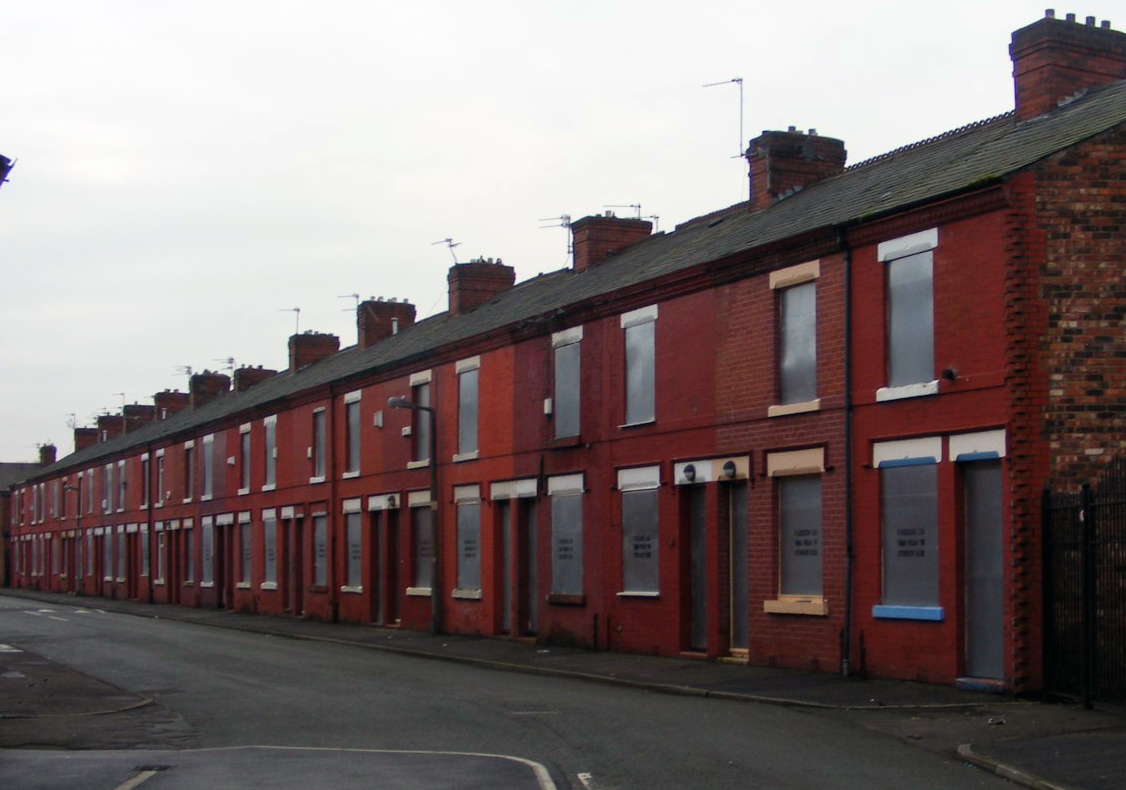
There are parts of Salford, Greater Manchester, that feel like a ghost town. Entire streets are lined with dormant, boarded up houses; old magazines are submerged in puddles by the side of cracked pavements; and there are piles of red brick where buildings once stood strong. The only sign of life is the occasional stray cat and the dull, ceaseless hum of engines roaring on the nearby motorway.

It was not always like this here. Salford was once a thriving hub of the industrial revolution. It was home to cotton factories, silk weaving mills and a bustling dockyard on the Manchester ship canal. Between 1812 and 1900, the city’s population increased from just 12,000 to 220,000 as thousands of families came seeking work. But with boom, eventually, there came bust.

Like so many industrial towns, when the factories closed, thousands of workers were left unemployed. The city was overcrowded and impoverished, leaving a legacy of social deprivation that has continued through to present day. As a result, Salford has been tainted by what one government report labelled an “image problem”.

In recent years, however, Salford Council has taken steps to regenerate and rejuvenate the city. “During the last decade, massive investment, more jobs, greater economic prosperity, improved environment quality and lower crime levels are changing the perception and image of Salford for the better,” says the Salford Council website. “More people are now choosing Salford as a place to live, work, invest, visit and study than ever before.”

Private developers have renovated old mills in the area into award winning accommodation and a state of the art ‘Media City’ is being built on a former industrial wasteland at Salford Quays. But behind the glossy veneer of the ongoing regeneration scheme, the city remains haunted by a darker narrative.

An astonishing 1500 of Salford’s streets have approximately been demolished in the last 50 years – many of which were torn down as part of an ongoing Housing Market Renewal scheme that aims to regenerate areas with low demand for housing. In order that these houses could be demolished, several residents were forcibly removed from their homes. Controversial compulsory purchase orders, which give residents no option but to sell their property, were issued to those who refused to move.

“We see casualties of this regeneration every day,” says Stephen Kingston, editor of the Salford Star, an award winning online publication that has spent five years researching the expenditure of public money on Salford’s regeneration. “People [are] living in derelict streets full of tinned up houses where developers have not shown interest . . . In all this time all we have seen is houses being knocked down, developers getting money chucked at them and not a lot of difference in the city's well being. By any statistics or analysis, Salford is still one of the most `deprived' areas in the country – which says it all really.”

Many of those whose homes were demolished under the redevelopment plans have now been moved to a 'regeneration zone' named New Broughton. Residents have complained, though, that the new houses are not up to the standard of their old homes. One survey recently conducted by New Broughton Residents Association (NBRA), for instance, found that 62% now felt they were worse off in their new accommodation.

“Everything about this place was done for outside appearance,” says Val Broadbent, one of the first to move into a New Broughton housing scheme called Supurbia, developed by Countryside Properties. “People passing comment on how nice it looks but living here is a different story.”

Val describes her new neighbourhood as “Toytown”, and says she was happier in her previous home – a 22-year-old ‘eco-friendly’ property, designed by Salford University, that has since been demolished by the council.

“I was very happy there, with everything I needed,” says Val. “Here we have been stripped of everything and given the very basics in housing. My old house had a secure driveway with lockable gates. Here I have a parking space in a communal car park that was sold to us as secure parking with electronic gate entry and monitored by CCTV. The gates never work and are wide open 24/7 and the CCTV never happened.”

According to the NBRA, there have been recurring problems with drainage, while several residents have reported damp and leakages. For the first 15 months after she moved into her Supurbia home, Val’s kitchen flooded every time it rained, eventually forcing her to get her entire kitchen ceiling replaced.

“It's just been a catalogue of errors,” she says. “Light fittings in the wrong place so that the light bulbs smashed when you opened the door, illegal plug sockets and even light switches missing. The aerial fell off the roof and the shower packed up . . . The front gardens are sinking and the paths need constant repair.”

Such problems are not unique to properties in New Broughton. A report produced by the Audit Commission in 2009 found that one in three homes across Salford is in poor condition, equating to a total of approximately 29,000. In 2001 the New Labour government set a target that all social housing would be ‘decent’ (warm, weatherproof and with reasonably modern facilities) by 2010, but Salford Council estimates it will be another five years until all of the city’s homes are up to this standard.

Yet even despite the high number of homes in Salford that are considered of poor quality, there is an 18,000 long waiting list for social housing in the city. Around 60 properties come available each week, and all prospective buyers must lodge a ‘bid’ against any they are interested in. On average, for every 60 properties that go on the market, more than 3000 individual bids are placed.

According to the housing charity Shelter, the huge demand for social housing in Salford illustrates that the council is not investing enough in affordable homes. In 2010, Shelter say, Salford council needed to build 1,327 houses to keep up with demand, though only 167 were actually delivered.

This is a problem that has been exacerbated by the ongoing recession. Rent prices are on the increase, while the coalition government plans to cut 60% – £4bn – from the affordable housebuilding budget. And though Chancellor George Osborne announced in his October comprehensive spending review that up to 150,000 affordable homes would be built by the government over the next four years, Shelter chief executive Campbell Robb says this is not enough.

“The proposed figure of up to 150,000 affordable homes over four years represent less than a third of what this country urgently requires to bring the housing system from its knees,” said Mr Robb. “The government must urgently set out its long term vision to solve our entire housing crisis or accept responsibility for the impact these policies will have on entire generations for years to come.”

Meanwhile, as private developers continue to build new housing schemes in Salford, the city’s residents remain unhappy about both the quality of the new homes and the way they have been treated by the council. The ghostly Salford backstreets, once full of life and activity, now serve for many only as a tragic, nostalgic reminder of better days.

“We are facing difficult times,” said Salford council leader, John Merry CBE. “It is inevitable that severe budget cuts will impact on some of the services we provide, but I stand by my commitment to this city and will deliver the best possible services to people in Salford with the remaining budget available."

------
I wrote this piece in late 2010, not long after the comprehensive spending review was announced. It formed the basis of a report I later put together for the Big Issue magazine, in January 2011.