Showing posts with label recession. Show all posts

The Occupy Movement and The Indignados

Friday, 28 October 2011


On the sweltering Madrid streets back in May, there was a strong feeling that something very significant was happening. Tens of thousands were crammed into a makeshift encampment in the city's Puerta del Sol square, unified by an acute sense of disillusionment with the political establishment. High unemployment, unaffordable housing and a feeling that politicians were not representing the people had resulted in the near spontaneous birth of a movement that would become known as the Indignados (the outraged), or 15-M (after 15 May, the date the protest began).

Everyone who was there and who witnessed it could sense that this was not any ordinary demonstration. Despite the bleak social and economic conditions that had sparked the protest, the place was buzzing with indescribable energy and an optimism for what could be achieved. It was a forum for all ages to come and debate how to create a better society; inspired by protests in other parts of the world – particularly across the Middle East – the aim was, in essence, to take control of history and swerve it in a different direction. "I am here because I think we can change something," said 20-year-old student Alejandro Jalón.

In the main, they were reformist as opposed to revolutionary, calling for electoral and media reform and an end to corruption and money in politics. Rejecting representative, parliamentary style democracy, they favoured direct, participatory democracy, with decisions made by consensus at public "general assembly" meetings.

Like the uprisings that had exploded onto the streets of places like Tunisia and Egypt, the Spaniards hoped their actions would spark similar protests across Europe. One 66-year-old man stood awestruck amid the crowds at Puerto del Sol and recalled the student and worker protests that swept parts of the world in 1968. What was happening in Madrid was of greater significance, he believed, because of its relationship to the uprisings in the Arab nations. "I think I am living a new world order," he said, without a quiver of doubt or hesitation in his voice. "I am sure it will spread."

His prediction was not far off. By late May protests had sprung up in over 60 Spanish towns and cities, and similar groups were formed in Italy, France, Greece and England. In London, activists organised a protest outside the Spanish embassy and called a public meeting on 29 May at Trafalgar Square. About 300 were in attendance, but they were predominantly of Spanish or Greek nationality.

"We are hoping that the British will join us too, because you have a lot to complain about," said 29-year-old Virginia Lopez Calvo. "We are sure that more people will join us if we continue to convene."

The 15-M, however, seemed to lose steam after the Madrid camp, which had become the beating heart of the movement, voted to disband in early June. Marches and demonstrations continued – some of which were suppressed by authorities – but lacked the same scale. The systemic change which at one point seemed to be within the clutch of the Indignados' grasp suddenly began to look like a faded dream. There was a moment when the movement itself appeared destined to fizzle out, as had the protests of 1968, absorbed into history before making any substantial political impact.

That was, of course, until a new wave of protesters exploded onto Wall Street, New York, in September, which injected a powerful double dose of energy and inspiration into not only the Spanish movement, but to similar protest groups across Europe and beyond.

Calling themselves "the 99 per cent" – a reference to the gap in income and wealth between the one per cent super-rich and the rest of society – the Wall Street protesters had themselves been moved into action after watching events unfold in Spain, Greece and the Middle East. Their anger, like that of their European counterparts, was borne on a basic level from the same sense of disillusion – even despair – at the political establishment and the lack of equality and opportunity within their society.

Dubbed the "Occupy" movement, the American protest, which is ongoing, erupted like a volcano into something far more politically radical than anything proposed by the Indignado reformists. Though it adopts the same participatory methods of direct democracy used in Madrid, the New York group completely rejects politicians and the traditional system of government – instead calling explicitly for a "revolution of the mind as well as the body politic".

By mid October Occupy-inspired groups – many forming their own general assemblies and tent-based occupations – had sprung up in over 80 countries and 900 towns and cities, including across the UK. "It's about finding a new way for people to actually have control over their own lives," said 32-year-old Tom Holness, a protester involved with an Occupy group in Birmingham. "At the moment our access to democracy is limited to going to a ballot box every five years and voting for people who are going to lie about what they're going to do."

Each of the groups' methods, goals and motivations are not necessarily the same, but they are united in their adoption of participatory democracy and their broad rejection of 'leaders' and hierarchical forms of organisation. Some are reformist, others revolutionary – all are vehemently opposed to the current political and economic status quo.

In cities across the world, there is now that same sense of indescribable energy and optimism that could be felt in Madrid's Puerta del Sol in May. It is contagious and continues to spread. There are some who believe it could be the birth of a new paradigm – the embryonic beginning of an alternative future unburdened by the cobwebbed shackles of party politics. Many continue to disregard it as a flash in the pan that can be ignored, though there is an increasing recognition that the Occupy movement and others like it cannot be dismissed out of hand for much longer. Mark Field, Conservative MP for the cities of London and Westminster, acknowledged last week that such protests posed a "huge challenge for the entire political class".

In the five months since the demonstrations in Madrid shook Spain, citizens on almost every continent appear to have simultaneously awoken from their slumber in unprecedented numbers, giving rise to all manner of possibilities that would have been unthinkable one year ago. No matter what the political differences between the movements in America, Britain, Spain, or elsewhere, there is a binding feature that is in itself incredibly powerful. It is a relentless, restless desire to fight for what is perceived to be a better, more egalitarian society – or "in defence of our dreams," as one of the slogans popular among the Indignados eloquently put it.

"Once in a while in history something will happen that will capture people's imagination," said Edward Needham, 43, a volunteer at Occupy Wall Street. "We're all at the start of this. Together there's not going to be anything that we can't achieve."


This article originally appeared at: http://www.newstatesman.com/the-staggers/2011/10/occupy-movement-madrid

Salford

Thursday, 17 February 2011


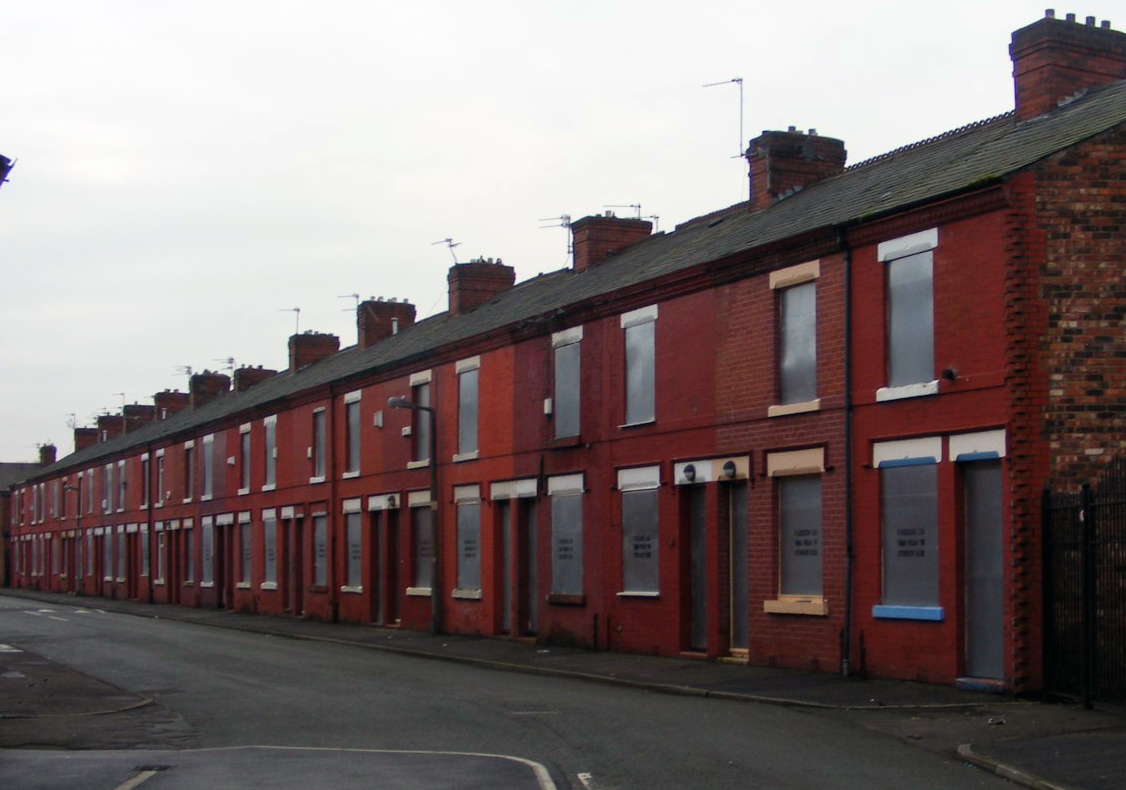
There are parts of Salford, Greater Manchester, that feel like a ghost town. Entire streets are lined with dormant, boarded up houses; old magazines are submerged in puddles by the side of cracked pavements; and there are piles of red brick where buildings once stood strong. The only sign of life is the occasional stray cat and the dull, ceaseless hum of engines roaring on the nearby motorway.

It was not always like this here. Salford was once a thriving hub of the industrial revolution. It was home to cotton factories, silk weaving mills and a bustling dockyard on the Manchester ship canal. Between 1812 and 1900, the city’s population increased from just 12,000 to 220,000 as thousands of families came seeking work. But with boom, eventually, there came bust.

Like so many industrial towns, when the factories closed, thousands of workers were left unemployed. The city was overcrowded and impoverished, leaving a legacy of social deprivation that has continued through to present day. As a result, Salford has been tainted by what one government report labelled an “image problem”.

In recent years, however, Salford Council has taken steps to regenerate and rejuvenate the city. “During the last decade, massive investment, more jobs, greater economic prosperity, improved environment quality and lower crime levels are changing the perception and image of Salford for the better,” says the Salford Council website. “More people are now choosing Salford as a place to live, work, invest, visit and study than ever before.”

Private developers have renovated old mills in the area into award winning accommodation and a state of the art ‘Media City’ is being built on a former industrial wasteland at Salford Quays. But behind the glossy veneer of the ongoing regeneration scheme, the city remains haunted by a darker narrative.

An astonishing 1500 of Salford’s streets have approximately been demolished in the last 50 years – many of which were torn down as part of an ongoing Housing Market Renewal scheme that aims to regenerate areas with low demand for housing. In order that these houses could be demolished, several residents were forcibly removed from their homes. Controversial compulsory purchase orders, which give residents no option but to sell their property, were issued to those who refused to move.

“We see casualties of this regeneration every day,” says Stephen Kingston, editor of the Salford Star, an award winning online publication that has spent five years researching the expenditure of public money on Salford’s regeneration. “People [are] living in derelict streets full of tinned up houses where developers have not shown interest . . . In all this time all we have seen is houses being knocked down, developers getting money chucked at them and not a lot of difference in the city's well being. By any statistics or analysis, Salford is still one of the most `deprived' areas in the country – which says it all really.”

Many of those whose homes were demolished under the redevelopment plans have now been moved to a 'regeneration zone' named New Broughton. Residents have complained, though, that the new houses are not up to the standard of their old homes. One survey recently conducted by New Broughton Residents Association (NBRA), for instance, found that 62% now felt they were worse off in their new accommodation.

“Everything about this place was done for outside appearance,” says Val Broadbent, one of the first to move into a New Broughton housing scheme called Supurbia, developed by Countryside Properties. “People passing comment on how nice it looks but living here is a different story.”

Val describes her new neighbourhood as “Toytown”, and says she was happier in her previous home – a 22-year-old ‘eco-friendly’ property, designed by Salford University, that has since been demolished by the council.

“I was very happy there, with everything I needed,” says Val. “Here we have been stripped of everything and given the very basics in housing. My old house had a secure driveway with lockable gates. Here I have a parking space in a communal car park that was sold to us as secure parking with electronic gate entry and monitored by CCTV. The gates never work and are wide open 24/7 and the CCTV never happened.”

According to the NBRA, there have been recurring problems with drainage, while several residents have reported damp and leakages. For the first 15 months after she moved into her Supurbia home, Val’s kitchen flooded every time it rained, eventually forcing her to get her entire kitchen ceiling replaced.

“It's just been a catalogue of errors,” she says. “Light fittings in the wrong place so that the light bulbs smashed when you opened the door, illegal plug sockets and even light switches missing. The aerial fell off the roof and the shower packed up . . . The front gardens are sinking and the paths need constant repair.”

Such problems are not unique to properties in New Broughton. A report produced by the Audit Commission in 2009 found that one in three homes across Salford is in poor condition, equating to a total of approximately 29,000. In 2001 the New Labour government set a target that all social housing would be ‘decent’ (warm, weatherproof and with reasonably modern facilities) by 2010, but Salford Council estimates it will be another five years until all of the city’s homes are up to this standard.

Yet even despite the high number of homes in Salford that are considered of poor quality, there is an 18,000 long waiting list for social housing in the city. Around 60 properties come available each week, and all prospective buyers must lodge a ‘bid’ against any they are interested in. On average, for every 60 properties that go on the market, more than 3000 individual bids are placed.

According to the housing charity Shelter, the huge demand for social housing in Salford illustrates that the council is not investing enough in affordable homes. In 2010, Shelter say, Salford council needed to build 1,327 houses to keep up with demand, though only 167 were actually delivered.

This is a problem that has been exacerbated by the ongoing recession. Rent prices are on the increase, while the coalition government plans to cut 60% – £4bn – from the affordable housebuilding budget. And though Chancellor George Osborne announced in his October comprehensive spending review that up to 150,000 affordable homes would be built by the government over the next four years, Shelter chief executive Campbell Robb says this is not enough.

“The proposed figure of up to 150,000 affordable homes over four years represent less than a third of what this country urgently requires to bring the housing system from its knees,” said Mr Robb. “The government must urgently set out its long term vision to solve our entire housing crisis or accept responsibility for the impact these policies will have on entire generations for years to come.”

Meanwhile, as private developers continue to build new housing schemes in Salford, the city’s residents remain unhappy about both the quality of the new homes and the way they have been treated by the council. The ghostly Salford backstreets, once full of life and activity, now serve for many only as a tragic, nostalgic reminder of better days.

“We are facing difficult times,” said Salford council leader, John Merry CBE. “It is inevitable that severe budget cuts will impact on some of the services we provide, but I stand by my commitment to this city and will deliver the best possible services to people in Salford with the remaining budget available."

------
I wrote this piece in late 2010, not long after the comprehensive spending review was announced. It formed the basis of a report I later put together for the Big Issue magazine, in January 2011.